
Self
How to Choose Between Online and In-Person Therapy: A Practical Guide
A neutral, practical guide to choosing between online and in-person therapy, with the research, real deciding factors, a comparison table, and a decision checklist.
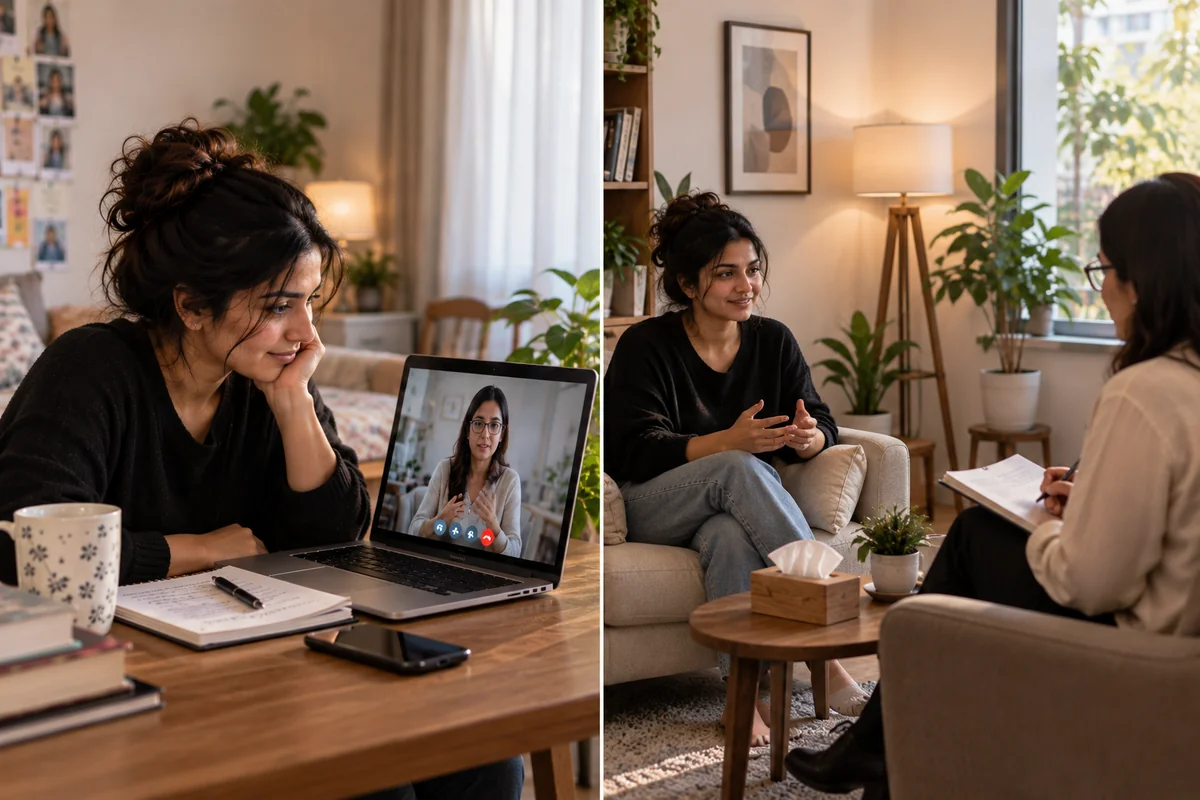
For most common concerns, online and in-person therapy work about equally well, so the right choice usually depends on your life, your privacy, your budget, and your comfort rather than on one format being better than the other. This guide walks you through the trade-offs so you can pick what fits.
If you are still working out whether therapy is the next step at all, it can help to first read how to tell when it is really time to see a therapist before you settle on a format.
What the research actually says about effectiveness
Let us start with the part that surprises people. When you look at the evidence side by side, research comparing online and in-person therapy finds the two work about equally well for most common mental health difficulties, including things like low mood, everyday anxiety, and stress.
The format is not the active ingredient. What matters is a good working relationship with a qualified therapist, a clear plan, and showing up consistently.
The evidence is also reassuring for structured online programs. For example, studies on therapist-supported internet therapy show it can meaningfully reduce anxiety when there is a real clinician guiding the process, not just an app on its own.
There is one more finding worth holding onto. Research on therapy suggests that how well the format fits your own preferences and comfort shapes how much you get out of it. In other words, the best format is often the one you will genuinely keep using.
The real deciding factors most guides skip
Since both formats work, your decision comes down to practical fit. Here are the factors that actually tip the balance.
Privacy in a shared home
If you live with family, housemates, or a partner, ask yourself where you would speak freely. Online only helps if you have a space where you will not be overheard or interrupted. If you do not, a private clinic room may protect your privacy better.
Continuity when you travel or relocate
If your work, studies, or life mean you move around, online therapy lets you keep the same therapist across locations. In-person ties you to one place, which is fine if your routine is stable but disruptive if it is not.
The time and money cost of commuting
Add up travel time, transport or fuel, and any time off you would need. Online removes the commute entirely. If getting to a clinic eats a whole afternoon, that cost may quietly wear down your consistency.
Comfort with screens versus in-room presence
Some people relax more talking through a screen from a familiar room. Others find a screen creates distance and prefer sharing a physical space. Neither is wrong. Notice which one lowers your guard.
Internet and tech reliability
Online sessions need a stable connection and a quiet, working device. If your internet drops often or your setup is unreliable, frequent glitches can interrupt sensitive moments and make sessions frustrating.
Severity and type of concern
For many everyday concerns, either format is fine. For higher-risk situations, or care that involves close monitoring, in-person or a blended approach is often the safer default. More on that below.
Online versus in-person therapy at a glance
| What to check | Online therapy | In-person therapy |
|---|---|---|
| Privacy at home | Needs a quiet private space | Private clinic room provided |
| Travel and time | No commute needed | Travel time and cost apply |
| Continuity if you move | Stays with you anywhere | Tied to one location |
| Tech requirements | Needs stable internet | No tech needed |
| Comfort style | Suits screen comfort | Suits in room presence |
| Higher risk situations | May not be enough alone | Often the safer default |
When in-person is genuinely worth it
There are situations where meeting in a room is the better call, not just a preference.
- Higher-risk concerns, such as thoughts of harming yourself, severe symptoms, or anything needing close clinical oversight.
- A strong personal preference for face-to-face contact, where a screen would make it hard for you to open up.
- No private space at home, where being overheard would stop you from speaking honestly.
If any of these describe you, treat in-person as your starting point. You can always add online sessions later once things feel more settled.
How to decide which format fits you
Work through these questions honestly. Your answers usually point clearly in one direction.
- Do I have a private, quiet space at home for a full session?
- How much time and money would a commute cost me each week?
- Do I expect to travel or relocate during my care?
- Is my internet and device reliable enough for video calls?
- Do I feel more open on a screen or in the same room?
- Is my concern everyday, or does it feel high-risk or complex?
If you have privacy, a decent connection, and a busy or mobile life, online is a strong fit. If you lack a private space, prefer in-room contact, or face a higher-risk concern, lean in-person.
One freeing point: this is not a permanent lock-in. Many people mix both, starting in person and moving online, or the reverse, as their needs change. It also helps to be clear on the differences between counselling, therapy and coaching so you match the format to the kind of support you actually need.
Making the choice with less second-guessing
You do not need the perfect answer, just a reasonable starting point you can adjust. Pick the format that removes your biggest practical barrier, whether that is privacy, travel, or comfort, and commit to a few sessions before judging it.
If you decide to go online, spend a little time on what to look for when choosing an online counselling service so the platform and clinician meet you where you are. Whichever you choose, the therapy still counts, and you can always change course later.
FAQ
Frequently Asked Questions
Is online therapy as effective as in-person therapy?
For most common concerns, the research finds the two broadly comparable in how well they work. What tends to matter more than the format is a good working relationship with your therapist and showing up consistently. Fit and continuity usually shape your results more than online versus in-person.
Is online therapy right for everyone?
No. Some situations and preferences are better served in person, as covered above. If you face a higher-risk concern, strongly prefer face-to-face contact, or have no private space at home, in-person is often the safer starting point. You can still add online sessions later.
How do I get privacy for online therapy at home?
Practical options include wearing headphones, using a room you can lock, or sitting in a parked car if your home is busy. You can also schedule sessions around your household, for example when others are out or asleep. If none of these work, in-person may protect your privacy better.
Can I switch between online and in-person later?
Yes. Many people mix or move between the two as their needs change, starting in one format and shifting to the other over time. Your choice now is a reasonable starting point, not a permanent commitment. Talk to your therapist about blending or switching if your circumstances shift.
Which format is cheaper?
It depends on your situation, so add up the full cost of each. In-person can carry travel time, transport, and time off work, while online removes the commute but needs a reliable device and connection. Compare the total practical cost, not just the session fee.